
First of all: de-energised
The whole job is carried out on equipment that is de-energised and completely disconnected from the mains. It is not a manufacturer’s recommendation, it is the condition of use set out on the technical data sheets of the only two products in the range suitable for this.
And the reverse order matters too: nothing is reconnected until complete drying is certain.
Why electronics degrade after the incident
Fire smoke deposits conductive particles and salts on boards, contacts and terminals. Those salts are hygroscopic: they draw moisture from the air and form a conductive bridge between tracks. The equipment can start up perfectly on day one and fail weeks later from track corrosion.
In a flood the mechanism is different but the result is similar: soluble contaminant left on the board and mineral residue as it dries.
Which product goes where
The range has two products for electrical work and they do different things:
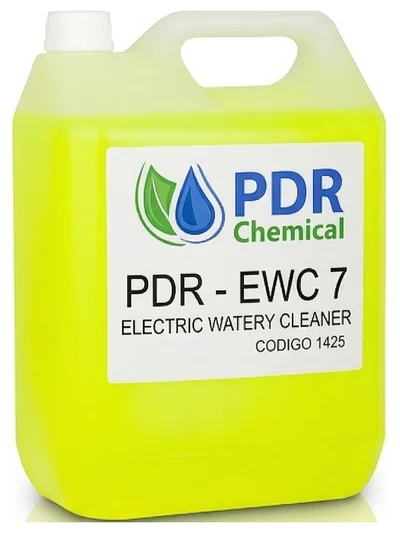
The PDR-EWC7 Electric Watery Cleaner is a neutral, water-based technical detergent, intended to remove soluble contaminants, hygroscopic residue and persistent soiling where solvent-based cleaning is not effective. It is used diluted: 1:20 for manual cleaning, 1:30 for machine cleaning, and 1:1 to 1:5 for heavy contamination.
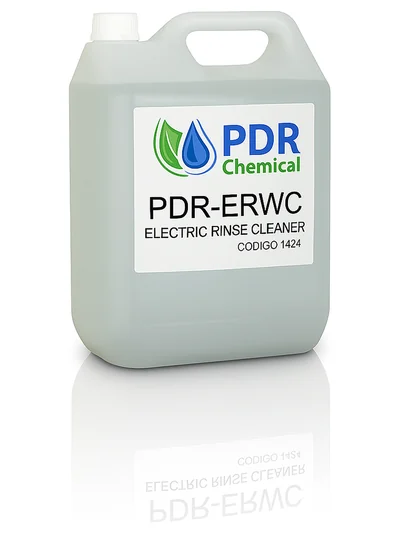
The PDR-ERWC Electric Rinse is the rinse: a solvent-based cleaner to remove detergent residue, salts and contaminants after water-based cleaning. It is ready to use and requires no further rinsing.
The usual order is the EWC7 to lift what is soluble and the ERWC afterwards to remove what the water-based product leaves behind and speed up drying.
Drying is not the end, it is part of the job
The EWC7 technical data sheet says so explicitly: it may leave residual moisture after application. After cleaning, that moisture must be removed with a solvent-based cleaner or isopropyl alcohol, and the equipment dried completely before being put back into service, preferably by forced ventilation or dehumidification.
In practice this means the drying phase usually takes longer than the cleaning, and that reconnecting too soon is the quickest way to lose a piece of equipment that had already been saved.
What must NOT be used here
In the compatibility table, the row for electrical panels and components is the only one where nine of the eleven products are marked incompatible. This is not over-caution: an alkali or an acid on a board leaves conductive residue and attacks the copper.
Only the PDR-ERWC and the PDR-EWC7 are suitable. No other product in the range should go anywhere near a panel.